
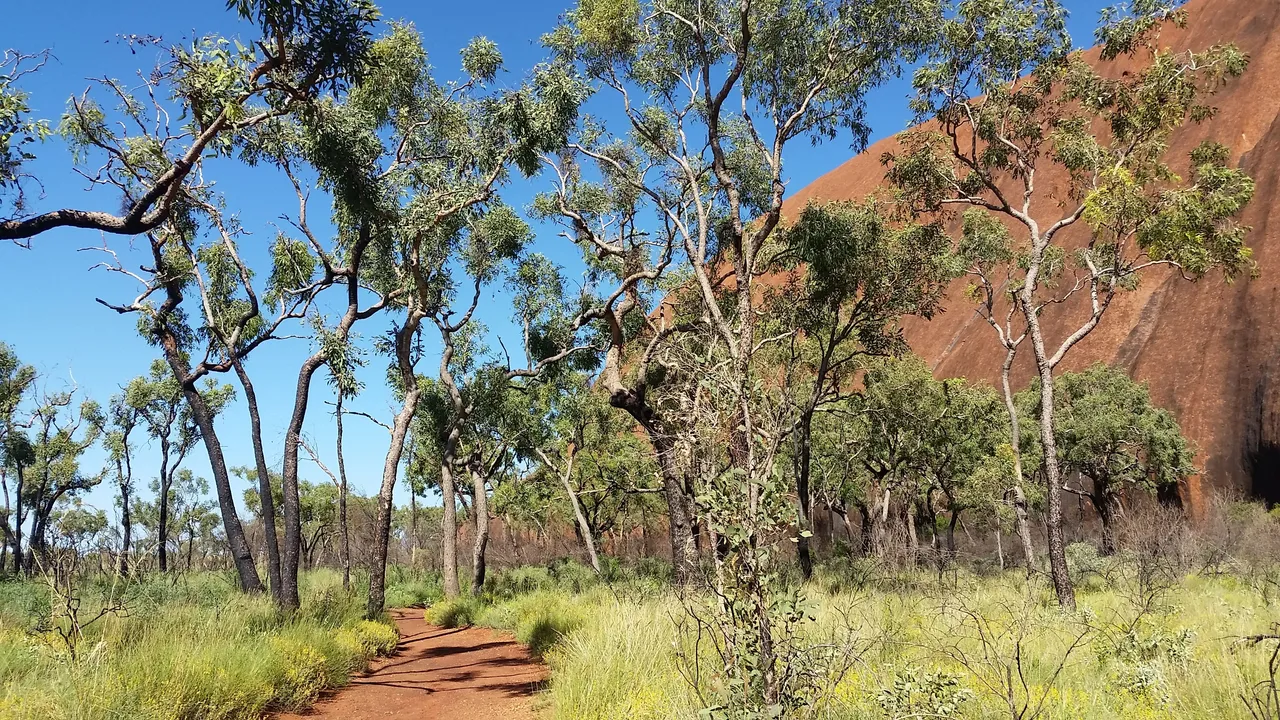
The Uluru base walk is 10.5 km around the famous Ayers Rock, one of the natural wonders of the world. It is dual-listed on the world heritage list for two reasons. One for its cultural value and the other for its natural beauty, special geographical formations, and rare animals and plants. My friends and I set off at about 7 o'clock in the morning on 18 Jan 2018 and completed the first part of the walk, which is called the Mala Walk, in relative coolness and shade. As part of the Mala Walk, we saw some of the paintings done by the aboriginal people and learned about how the boys were taught to hunt and the girls were informed on gathering food and cooking.


Although there are many signs asking visitors not to climb the 348 meter-high Uluru, we saw many people had already embarked on the climb up a steep incline when we arrived. Before going to Uluru, I had heard that people are discouraged from climbing the Rock because the Yankunytjatjara and Pitjantjatjara people regard this place as sacred, and as a sign of respect, visitors should not climb. It was only after listening to an ecological guide that I found out more about why we shouldn't climb Uluru.
First of all, many people don't bring enough water and they end up dehydrated when they get to the top of the mountain, which means they have to be airlifted down. The helicopters that bring them down cause damage and pollution to the Rock. Some people (35 so far) have even died attempting the climb.
Much more interesting in my point of view is the fact that there are tiny shrimp-like crustaceans known as shield shrimp that live on top of Uluru. They are like sea monkeys: when there's water the eggs "hatch". The reason they are there is because Uluru used to be submerged underwater, according to the Guide, so when people climb up to the top and step on it with their shoes, they are actually killing the shrimp.


The third reason one should not climb is also an environmental one. Some people drink coffee in the morning before they head out to Uluru and when they reach the top of the Rock, they end up needing to go to the bathroom (of course, there are no toilets up there). Their urine kills the shrimp. Furthermore, when it rains, the urine all comes running down to the water holes at the bottom. The animals who drink this water then fall ill. These reasons should really convince people not to climb Uluru!
At least half of the base walk is not shaded, so it was quite a grueling walk due to the heat (40 degrees forecast for that day). We saw some people on Segways and others on bicycles and wished we had chosen those methods to get around Uluru. However, the walk is still worth doing on foot because you can pause often to appreciate the different facets of the Rock.

There are numerous crevices and the shadows cast upon the Rock were also very interesting. Some sections of Uluru are sensitive sacred areas which you cannot photograph, so I am only showing you the parts where photography is allowed.




All photos taken with my Samsung Galaxy s5.
!steemitworldmap -25.343637 lat 131.037037 long Uluru base walk D3SCR
