
If you treat nature the right way, she provides with what might feel like an abundance of food. If you know how to grow or forage wild herbs, you can easily eat for “free”. Buying, for example, a bag of spinach can set you back anywhere from $1 to £2 to 3 AUD $. Buying it multiple times in a month might start to rack up. Doing that for a year, or for the rest of your life, the price might climb into the thousands. If you grow spinach and other related leafy greens, you have the benefit of having your pantry in the garden, using always freshly picked produce. And you have the added benefit of exercise and getting some vitamin D from the sun. And that does not even cover the potential health benefits of mixing different sorts of leafy greens.

In the following recipe, I want to share with you how I use different wild and cultivated herbs or leafy greens in a very easy and I would argue healthy soup. It is summer here in South Africa, not soup weather, but earlier this week we had a spell of cold weather and heavy rains. Perfect weather to use some of the abundance of leafy greens growing in my garden. I have 5 types of leafy greens that are either flourishing at the moment or just starting to produce some valuable leaves. The cultivated crop is my swiss chard, producing what feels like heaps. The wild herbs are some biggish dandelion leaves, two varieties of amaranth, and the trusty nettled-leaved goosefoot. Mixing these leafy greens into a soup yield something that I think is really healthy and superior to anything you can buy at the shop. It is fresh and you made it yourself, plus if you can, you also grew the food yourself.
“Instagram Reality Food” and Food as Medicine: A Brief Divergence
We are all used to it by now, at least those on social media: beautiful images of food that lure you in and when you try to make it yourself, it either flops or it is more work than was alluded to in the image or video. I call this “Instagram Reality Food”, that is, food that is prepared for Instagram or social media rather than people to eat. Making food for other’s approval and to win over the “social media algorithms” essentially leads you to make substandard food. For example, when baking sourdough bread the window you have to bake a nice loaf with big holes and a nice open structure, you follow a different recipe and method. Fermenting the dough for longer will not necessarily lead to a nice open crumb but fermenting the dough for longer will yield a healthier product. So, the decision you need to make is between an “Instagram” ready bread or a healthier bread.

Another example is the soup I am making today. There is no debate: it is not the most appetizing looking soup. I could have strained the soup with a fine mesh strainer, and it would have looked velvety smooth. But now my question, for whom would that have been? In fact, doesn’t straining remove some of the fibre of the food? Here is the only article I could find that kind of affirms this, but we know that straining the pulp out of fruit juice removes the fibre and leaves mostly sugar behind. I could have strained the soup so that it looks better, but am I then not removing some of the nutrition? I would in effect move from “food as medicine” to “Instagram reality food”, from nourishing my body to feeding the algorithm, and so on. The choices we need to make. I opted not to strain my soup. You do you. Sorry, divergence over. On to the recipe and method!
Recipe
For this soup you will need:
I used a bunch of different leaves:
- Amaranth leaves,
- Marog leaves, (see my post on this herb and why we call it African Spinach)
- Dandelion leaves,
- Nettle-leaved goosefoot leaves, and
- Swiss chard.

The other ingredients:
- A couple of potatoes,
- Onion,
- Swiss chard stalks,
- Garlic,
- Water, and
- Spices (I used salt, pepper, and smoked paprika).

Method
This soup is really easy to make. I firstly cut the onion and Swiss chard stalks into small cubes.
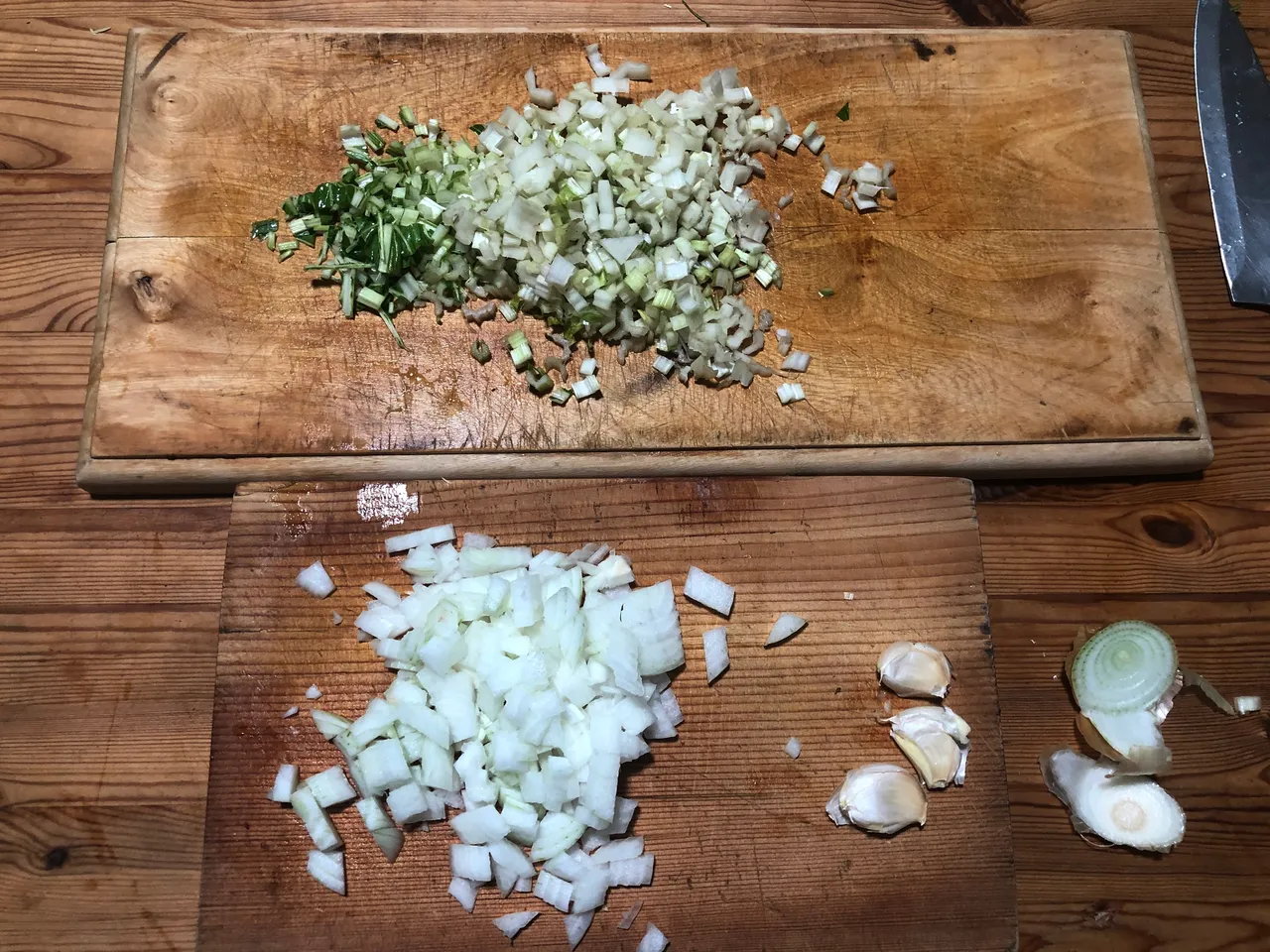
I brown the onion and Swiss chard stalks in some coconut oil.

I cook the potato in the microwave for a couple of minutes. You can obviously cook the potato any way you’d like or prefer. The reason you use the potato is as thickening agent for the soup. Rather than using flour or something similar, the potato adds to the richness of the soup, but it also adds healthy nutrients as well. Flour is a rather nutrient poor food. Potato is much healthier and not that expensive. Or the goal is to grow it yourself!


After adding the potato and garlic, add some water. Boil this for a couple of minutes and add the spices of your choice. I added some smoked paprika to add some smoky flavour but also some umami elements.

I then added the leafy green mix that I chopped into smaller pieces. I cook or boil them for only a minute or two. You do not want to cook it for too long.

You can then choose how and how much you want to blend the soup. Leaving it as is will result in a chunky soup that is not thick (as the potato needs to be blended). I used an immersion blender to blend it until almost smooth. As noted, you can strain the soup to make it smoother and more presentable, but essentially you will remove some of the nutrition.
I finished the soup with some olive oil in fancy patterns. I felt my inner abstract artist taking over when I poured the olive oil. I added some roasted nuts in the centre and for some crunch and textural contrast.

Have you experimented with cooking different leafy greens? What is your favourite method and recipe? Please share in the comments!
