
Euphorbia globosa Cyathium

I fiori delle Euphorbie sono sempre stati un po' insoliti, tanto da avere un nome tutto loro, ciazio.
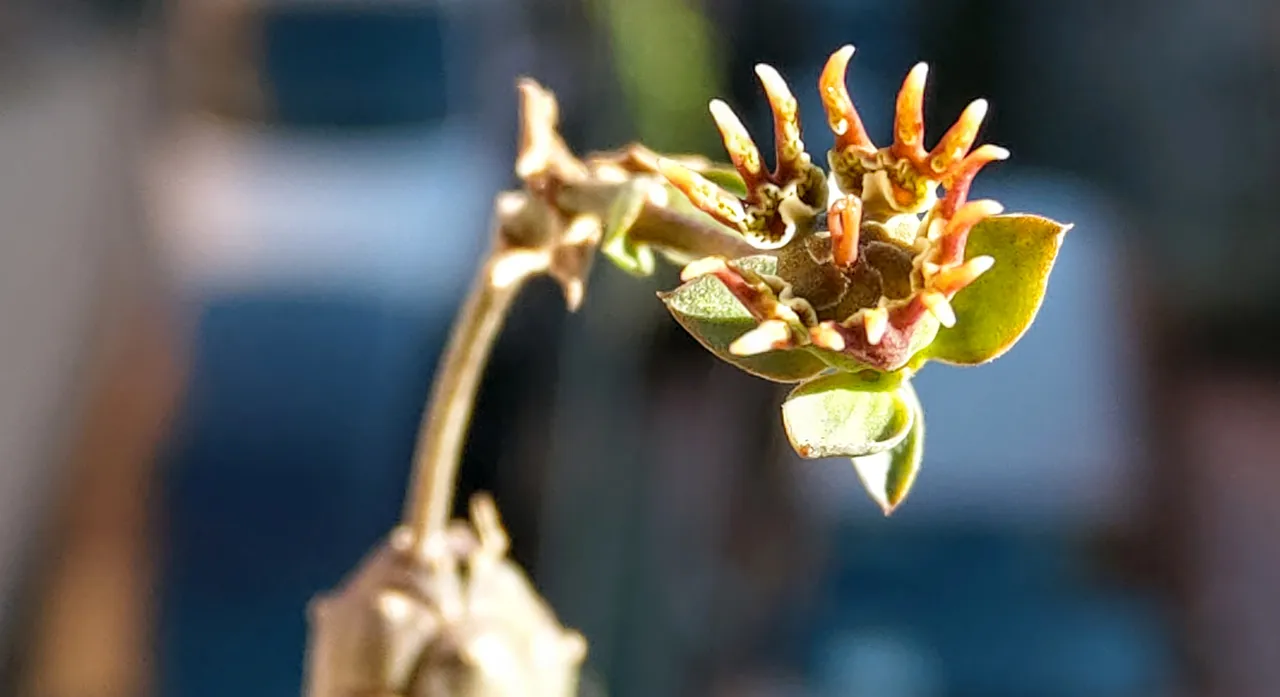
Questo che vedete è il ciazio di un' Euphorbia globosa, pianta endemica del South Africa.
Non ho ancora ben capito se la pianta è dioica oppure no, ma guardando la fioritura durante questi giorni ho scoperto che ci sono 2 fasi distinte durante lo sviluppo del fiore, ma non so dirvi se è una normale fioritura oppure un caso di ermafroditismo.
The flowers of the Euphorbie have always been a bit unusual, so much so that they have a name of their own, ciazio.
What you see is the ciazio of an Euphorbia globosa, an endemic plant from South Africa.
I have not yet understood whether the plant is dioecious or not, but looking at the flowering during these days I have discovered that there are 2 distinct phases during the development of the flower, but I cannot tell you if it is a normal flowering or a case of hermaphroditism.
Come si vede dalla foto che segue, in un primo momento la pianta si presenta come femminile facendo uscire lo stigma centralmente come nel ciazio di destra.
As you can see from the photo below, at first the plant appears as female by letting out the stigma centrally as in the cyathium right.

Nel ciazio di sinistra invece, si può notare come le brattee (o ricettacolo?) si sono aperte come fosse un' otturatore di una fotocamera, mettendo in mostra gli organi maschili (ovvero i stami con le antere) sottostanti.
Questo potrebbe essere un buon modo per favorire una mescolanza genetica evitando un'autoimpollinazione col rischio di una prole simil identica al genitore, un po' come il fiore della Dionea muscipula.
In the left ciazio instead, it can be seen how the bracts (or receptacle?) Opened as if it were a shutter of a camera, showing the male organs ( the stamens with the anthers) below.
This could be a good way to favor a genetic mix avoiding self-pollination with the risk of a similar offspring identical to the parent, a bit like the flower of the Dionea muscipula.


In questa "sezione" si possono notare meglio gli organi maschili situati all' "interno".
In this "section" you can better see the male organs located inside.

Il bianco che vedete è il classico lattice comune a tutte le euphorbie che per chi non lo sapesse è generalmente tossico e bisogna evitare sempre il contatto con la cute, specie con gli occhi.
The white you see is the classic latex common to all euphorbias, for those who do not know it is toxic, irritating and you must always avoid contact with the skin, especially with the eyes.


Il fusto ho notato che si presenta "clavato" durante la fase di crescita per poi assumere una forma sferica una volta maturo. Anche la forte esposizione solare favorisce fusti più omogenei e rotondi, piano piano la sto abituando ad un'esposizione solare totale.
The stem I noticed that it appears "clavate" during the growth phase and then assumes a spherical shape when mature. Even the strong sun exposure favors more homogeneous and round stems, I'm slowly getting used to a total sun exposure.


Tutte le foto sono di mia proprietà
All photos are my property
Potrebbe interessarti anche ...
You may also be interested ...
| Gymnocalycium | ||
|---|---|---|
 Gymnocalycium mihanovichii var. friedrichii |  Gymnocalycium achirasense var. orientale |  Gymnocalycium baldianum |
| Mammillaria | |||
|---|---|---|---|
 Mammillaria spinosissima |  Mammillaria tulensis v. stachelosus |  Mammillaria hahniana and glassii |  Mammillaria carmenae |
 Echinocereus scheeri ssp. gentryi |  Echinopsis hybrid |  Echinopsis subdenudata |
 Rebutia perplexa |  R. pulchella var. prolifera |  Notocactus uebelmannianus |
 Stapelia gigantea |  Turbinicarpus schwarzii |  Lithops sp. |